Saturday, September 23, 2006

International relations

A Scotsman and two men from Myanmar (M1 and M2) are walking home from a night out downtown Princeton.


The Scotsman asks M1, 'What hall are you in?'


M1 replies, 'I'm old, 37, 38.'


'No,' says the Scotsman, 'what hall are you in?'


'Ah,' says M1, 'Brown Hall.'


M2 joins the conversation: 'Are you hot or cold?'

M1 says, "What?'


M2 says again, 'Are you hot or cold? D asked if you were hot.'


These guys are not daft - they're just in a very different country, speaking a second or third language.


When in Myanmar one of them translates the Bible into one or two languages. He can tell you about the etymology of the word 'christ', and many other standard points of information that few Christians here really know or care about.


The other became the only Christian in his village when he decided to follow Jesus Christ. He had to leave the village. He'd never seen a wine bottle with a cork until this week.

And tonight both these men taught me some more about the meaning of life. Can any Christian really doubt that God works for good in all things?

Wednesday, September 20, 2006

Ruff day


Yesterday I saw a man wearing a ruff - and, I don't think he was having a laugh. No, he was in earnest. It was the Opening Convocation for the 195th Academic Year at Princeton Theological Seminary...

All incoming students enjoyed a reception at the house of President Iain Torrance. We then tottered over to the steps of Miller Chapel for the Class photograph. Then it was dinner with the President and Faculty. Then the convocation service, where Professor Gordon Graham gave his inaugural lecture as the new Professor of Philosophy. Then a few of us went downtown to unwind.

It was a great day. The more people I meet here, the more I feel pretty out of my depth. You bump into former moderators of the Church of Scotland - but they are the least impressive of an illustrious community of Christian people. Numerous international students on my Th.M. course who are pastors, and who teach at seminaries. American nationals who are top notch scholars and professionals (e.g. one individual who received a distinction working at Cambridge with John Polkinghorne).

Daft thing is, I keep forgetting to carry my camera - so, sorry, but you'll have to make do with the animated ruff. (Seriously, one of the Deans was wearing a ruff round his neck...)

Monday, September 18, 2006

Mostly coffee and donuts...

I've been in Princeton 12 days now. It doesn't feel as if I've really done very much at all. I've completed an orientation program, I've visited Witherspoon Presbyterian Church twice, I've played basketball, I've had lots and lots to eat and drink, I've wandered around downtown Princeton, I've read three and a half books, I've met more people than I can remember, and I'm about to start my first week proper. To be honest, I'm looking forward to the normality of a routine. Sometimes being new in a place can get tiresome.

But there is lots to look forward to, and lots to think about. Today, I attended a lecture about Princeton and the civil rights movement. Apparently the town is something of an enigma in this history. On the one hand, up until the mid-20th century it was regarded as a northern town with southern attitudes, or a southern town in the north. But it was one of the first towns to desegregate schools. Of course, revision of all this history is now questioning just how effective this desegregation has been - according to one woman in Witherspoon Church, a black woman who experienced this change, black children only became aware of segregation and racial inequality when they started attending mixed schools.

This week all Princeton students have the opportunity of unlimited free rail travel to New York. I'm planning 3 trips - one on Thursday, one on Saturday, and one on Sunday. The Sunday trip will be a visit to Redeemer Presbyterian Church - I'm choosing the early evening service - jazz style - nicee!

Tomorrow, I meet my advisor of studies - Dr James Moorhead - he's a specialist in 19thC American Church History - my kind of guy - grreat!

Princeton People


Samuel Miller lived here:


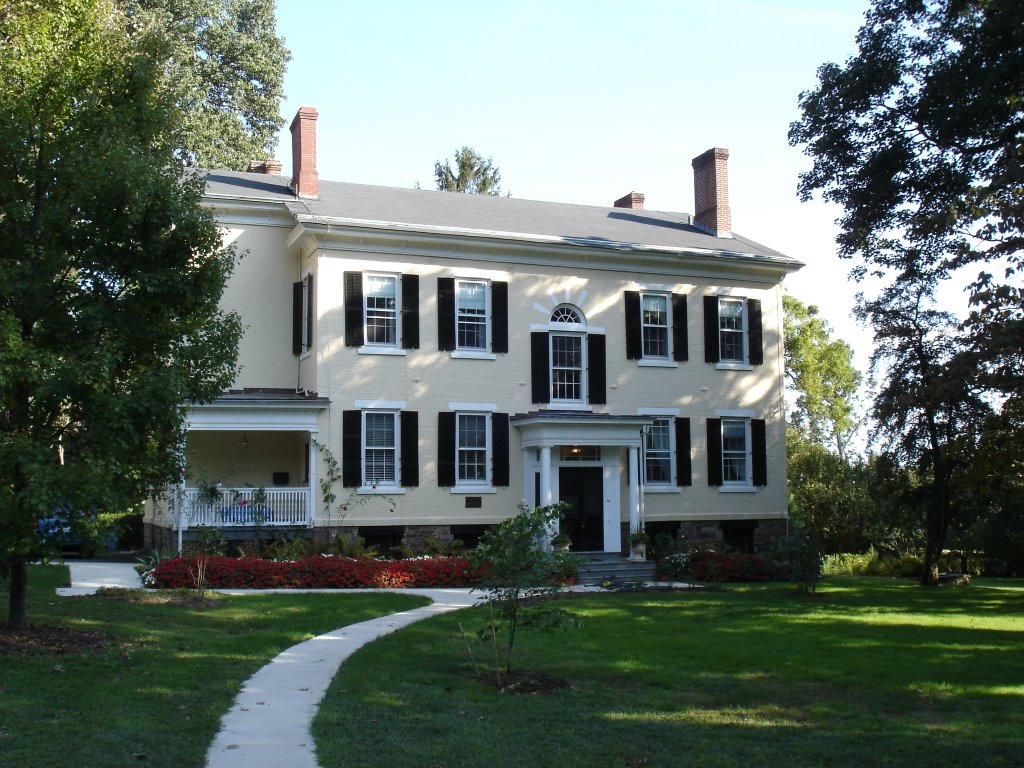
Charles Hodge built this house, and lived in it for over 50 years. I've read that Benjamin B Warfield lived in it too during his Professor years.


Einstein lived here:


Shedden lived here:

Wednesday, September 13, 2006

Barth for breakfast


Church Dogmatics IV.1 The Doctrine of Reconciliation - my major reading for a class on the doctrine of atonement with Bruce McCormack. T.F. Torrance wrote that CD IV 'surely constitutes the most powerful work on the doctrine of atoning reconcilation ever written.'

I'm really looking forward to it, and I'll try to relate this reading to current debates among evangelicals about the doctrine. I'll probably have to write a class paper, perhaps I'll post it some time next semester.

This post is dedicated to my friend, my student minister colleague and my mentor in all things Barthian - all one and the same person, Keith Edwin Graham.

Tuesday, September 12, 2006

The beginning

Took my first book from the library today. Shedd's Lectures upon the Philosophy of History, first published in 1856 I think, and based on lectures given by Shedd in winter 1853-4, as he taught church history at Andover Theological Seminary. The edition I'm about to read is dated 1861 - more interestingly, the volume was donated to the library by someone called President Paton... I'm guessing that this was Francis Patton, PTS president from 1902-1913.

I'll post a review and thoughts on this book at my Shed on Shedd blog in due course. It will be the foundation for my proposed dissertation on Shedd - I've ordered his Dogmatic Theology from Amazon.com - and I'll try and read most of his other major published writings, as well as lesser but no less interesting work, such as his contributions to the Confession debate in late 19thC Presbyterianism, and his Literary Essays. (Shedd taught literature before becoming a theologian - he edited an edition of the works of Coleridge.)

You can find my Amazon.com wish list here.

On the steps of Miller Chapel

Stateside

One week can be a long time in politics. So far Shed in Princeton hasn't been the catalyst for any revolutions - apart from the revolution in his own life, perhaps.

I'm writing this from my top floor dorm room in Alexander Hall, Princeton Theological Seminary, on my brand new Toshiba Satellite Notebook. Ten days ago I was working on an old IBM desktop pc (Windows 98). I was in my little flat in Glasgow. Here I am today in the US, and finally in the 21st century with my laptop an' all. Part of me feels I've arrived - maybe it's just the jetlag still affecting my emotions.

It's going to be a great year. I've already started to make some good and interesting friends. I'm already fascinated by all things American. The huge 'Welcome to the United States of America' in the lobby at Newark Airport was matched by a huge advert for Accenture that used Tiger as an all American hero. Newark is the first airport I've been in where I had to pay for the use of a luggage trolley... but, New Jersey is the first place where I've seen baby changing facilities in male restrooms. One of those things must be progressive I guess.

For the last week I've been settling into Seminary life at PTS. About 25 international students are being oriented in all things necessary to survive 9 months here. I've been impressed by the care and thought that has gone into the program. We have been well looked after. For example, the canteen was closed over the weekend, so we each got $70 petty cash to spend on food (effectively, to cover only two meals, because we got breakfast boxes both days, and we were at two bbqs too.)
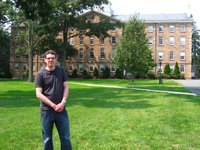
The seminary is pretty cool. The campus is smaller than I thought it would be. Opposite is me standing in the heart of it all, with Alexander Hall in the background. At the moment the place is pretty quiet, but it will get busier next week when all the normal students return to read Barth and stuff. I've already met some returning students, including my dorm deacons (Hudson and Jeff). These folks all seem fairly cool, young and sorted. I'm going to have to work real hard to fit in - but I'll try, even if I stop short of smoking a pipe. (Yes, that seems to be the cool seminarian thing to do!)

The place is just full of history. Perhaps I'm just too familiar with some of the figures of that history. But I get tingles when I read plaques with names like Hodge, Warfield, Green, Alexander, and Miller on them. I'm just not sure how many people here really understand or appreciate that legacy. Early days so far, but I've yet to meet anyone who really knows the work of these guys well.

Today is 9/11. In the last two days I've started to really notice stuff about the US. I had hoped to write about that in this first post, but I'll have to leave it until later. I'll leave you with my experience of church on Sunday morning. I heard a stirring sermon, critical of the powers that be, making mention of Iraq, Katrina, 9/11, lies, slavery. It was the first 'liberation' sermon I've heard where a really important question was asked, even if it was only in a passing comment: 'Who might God be against in our time?'

I think liberal and conservative preachers alike need to preach on this theme to recapture a prophetic spirit. 'Justice and peace' Christianity doesn't preach God's judgement on oppressive powerful people in our world. It tends to be hopelessly weak because it is tied to a universalism that guts its message of any relevance. All is ultimately pie in the sky for everyone, so why bother about today.

On the other side, conservatives are too concerned with saving a lost cause (the church in the West) to really speak the gospel message to a desperately needy world. If they gave up that cause they might find that people started to listen. After all, conservatives and liberals love to use the same prophetic texts - texts that speak of judgement, justice, hope, peace, and love. These texts speak about God too - I think most people have forgotten about him though - they certainly don't like to refer to 'him' - God is slowly becoming a concept rather than a named, personal being who feels, thinks, responds and acts because he cares. I will probably have to think again about the inclusive language debate, the gender question, and all those tiresome issues that strangle the spiritual life out of most of us in theological studies.

One conversation illustrated all this for me. After the service on Sunday morning, a man turned round to greet me. He asked if I knew anyone in Scotland with a peculiarly Scottish name (McEwan). This man himself was a McEwan. His family had come from a plantation in Tennessee, and the owner had been a McEwan, from Glasgow... The Scottish influence here Stateside is mixed, and it is still fermenting. I think I'm going to learn loads of stuff over the next 9 months, about history and theology, about the US and about other countries too, but mostly about myself. You have all been warned!

Friday, September 01, 2006

America


On September 6th I fly to Newark, NJ, to begin life as an international student at Princeton Theological Seminary. I am getting picked up at the airport by seminary people.

For the next few days I'll be preparing for this trip, packing stuff to take, and taking care of things that need to be sorted before I go.

My next blog post will be written in the USA! I expect the first week or so I'll be dizzy with excitement. You can look forward to some sensible posts from the middle of September onwards.

Wednesday, August 23, 2006

The Call

Here's a review of one of my favourite books. The review originally featured in an edition of Tron Times, the church news letter of St George's Tron, Glasgow. I think I wrote it in 2003. Everyone should read this book.
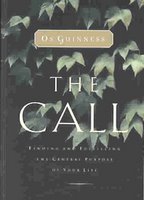
Os Guinness. The Call: Finding and Fulfilling the Central Purpose of your Life Spring Harvest & Paternoster Lifestyle. 249 pages


At home, in my study, I have a bookcase within reaching distance of my desk. The most important shelf in this case is level with the desk. I can reach anything stored there without standing up. Here, I keep the most important books I have read. Not necessarily the books that changed me most, or those I enjoyed reading. Not even the great books on the Christian faith, written by the likes of Calvin and Owen. But those books I will read again. Books I know I can refer to in times of doubt, when I need to be encouraged, or reminded about the important things in life.

I bought The Call about this time last year, and finished reading it while I was away from home working in England. My first instinct was to keep it in a place that was close to hand and so, on returning to Glasgow, it found a place in my special shelf.

Why is this book special? Well, at first sight it doesn’t seem so. The cover gives little away. Indeed, the title would normally arouse my contempt and suspicion: “Not another book on discovering God’s will…” There is no foreword or introduction. Only a note at the end of the contents page gives a clue about what Guinness has given us. The chapters – 26 in all – are intended to be individual meditations. Yet, together, they guide us through all the channels of working out what life is really about, and what God’s calling means.

Each chapter is not more than 12 pages. However, they are all packed with stories of significance. Each story illustrates an aspect of calling. This theme is further illustrated, discussed and thoroughly applied to the world, and our place in it. These illustrations are meaty in themselves. They are taken from the lives and writings of great men and women of the past. You will learn more about history in this book than you will in most history books.

What is God’s calling? Well, it is not the same as trying to determine God’s will for your life. However, it is related to that search. Here is what Guinness writes in the first of his meditations: “Calling is the truth that God calls us to himself so decisively that everything we are, everything we do, and everything we have is invested with a special devotion and dynamism lived out as a response to his summons and service.” To summarise this argument, everyone, everywhere, and in everything should think, speak, live, and act entirely for God. All of this is to be through Christ, and for Christ. We are not called to something (job, relationship, role), or somewhere (the inner city, or Outer Mongolia). We are called to Him. Everything else – our work, our relationships, our desires – must rest on this foundation.

Radical and orthodox. That is one way to describe the impact of this book. Protestant and Catholic distortions about calling and vocation are described and ditched as inadequate and harmful to spiritual growth and maturity. The ideologies and trends of modern life are put to the test, and found wanting. But the reader is forced to think about his or her own values. Do we live for ourselves, or have we heard and answered the call of Jesus of Nazareth? Are we prepared for the cost and the pain involved in that vocation?

Os Guinness will not write a more enduring work. If you like good, elegant writing you will revel in its pages. The style is not light, so be prepared to re-read sentences, or think through paragraphs. You will discover truth and insights that should change your life for good. Aimed primarily at Christians, any thoughtful man or woman will enjoy this book by one of the great, popular thinkers in the church today.

Tuesday, August 22, 2006

Fun with Fivers

The latest on Sheila's fiver from Varwell.

Rumour has it that Simon will be making an appearance at my 'going away to Princeton' party/event. Varwell's people are keeping quiet about the rumours - plans to control the crowd are already being put into effect.

Another disclaimer

In case you didn't read this post, let me say again that I don't agree with everything posted on the blogs that I advertise on itothehills. I'm slowly but surely turning itothehills into my home page on the web. At Princeton, I hope to study full time online. My blogs will become the windows of my learning and my writing. You will be able to follow that learning through Shed on Shedd, Shed on Strong, and itothehills too.

So, in case you read Mark Driscoll, I just want to share with you my concern about the tone of his latest post. Those of you that know me, know that I've got serious issues with the Church of Scotland's law. So, I can understand Driscoll's views.

(I refer to the Kirk's law, because it appears to me that the Kirk is founded on what is effectively a combination of case law and law 'by committee report'. Faith, belief, and practice feel entirely separate from this 'legal' construction. Your attitude to the Kirk in general needs to refer to its law, rather than individual churches or members in the organisation. In practice, ministers have to uphold the law of the CofS above anything else.)

My problem is that Driscoll's post as a whole just plays to his audience, and presumably it aims to attract disillusioned mainliners. It's not surprising that Driscoll jnr agrees with his mega cool, mega manly, mega church pop star Dad, either. Driscoll's continuing success relies on the confusion (and the destruction?) of the mainline churches.

It strikes me that so many preachers and church leaders need some kind of foil. Why is that? Is it some Hegelian thing going on? Or is all just hubris? I used to preach in a style that assumed an opposing side, or an opposing argument, to everything that I was saying. I preached as if I was trying to win a debate - booorrrrrinnnggggg!!!!

I think preaching that majors on undermining or attacking 'error' lacks... well, something. I now try to tackle error and ignorance through the winsome declaration of truth. If people have problems or issues, that will soon enough become apparent in the ongoing pastoral relationship...

'Rev Shedden, I was wondering if you could defend the 4th point of Calvin's Famous Five for me...' Realistic - I think not. More to the point - 'Dave, I'm feeling really crap at the moment...'

PS
This mega church story is hilarious. Poor Pastor Boyd's only left with 4000 members in his church.

Monday, August 21, 2006

Problem solved

I might be able to enjoy leisurely breakfasts at PTS after all. There is at least one combination of worthwhile courses that leaves my mornings free. Of course, I'll be reading theology with my cornflakes and over-easy eggs on toast. Someone's got to do it, so it may as well be me. Read itothehills over the next week or so to find out my study and reading plan for the next year.

Saturday, August 19, 2006

Friday, August 18, 2006

National Gallery of Scotland

Today I travelled through to Edinburgh. It was my last opportunity to see an exhibition of Rembrandt etchings.

Alas, there were no postcards of any of these etchings in the gallery shop. I've experienced this disappointment with gallery shops before - I can never get a postcard print of the picture that caught my imagination. Perhaps I've just got a weird imagination compared to Joe Public.

Galleries are great! Lots of families, with parents totally unable to answer questions from kids: 'Mummy, who's that?' 'Lu..ther. Luther.' (The picture was strange, but it depicted Luther's breakthrough on the doctrine of justification by faith alone. I'd say more, but there was no postcard available...) Lots of people saying really silly things: 'I've seen that before somewhere... Aye, I've definitely seen that somewhere before.' (This time, we're talking about Raeburn's 'Reverend Robert Walker Skating on Duddingston Loch' - the single most famous Scottish picture, ever, perhaps?)

One highlight today was this: The Trinity Altar Piece by Hugo van der Goes. I'd never seen it before. First thing I thought was: who's that bloke like Jesus holding the body of Jesus? My little head couldn't work it out until I read the title of the work.

No matter how you understand and apply the first two or three commandments, you've got to marvel at the theological understanding behind this image. Almost as much as you've got to marvel at the realism of Rembrandt's biblical etchings and paintings. I don't remember seeing an artisic representation of God the Father that portrayed his likeness to the Son. Or, should that not be the other way about? Therein lies the problem of such art, and the wonder of the triune nature of God.

Who is Simon Varwell?

Find out at www.simonvarwell.co.uk!

I had the pleasure of meeting Simon for two or three drinks two weeks ago. It was my first 'blog' date. However, there was at least one connection, so it wasn't entirely blog-random. (I know Simon's brother from my time on Skye last summer.)

Varwell is not only a top-quality blogger, he's also interesting and funny and talented. All these come together in many of his schemes - the Mullet Search, and the Church Search being two classic examples in his career.

But here is another scheme in the making - hilarious, will we ever dare write our names down again?

Thursday, August 17, 2006

Wine Wisdom and Song

My latest sermon.

Loosely based on a true text, Ephesians 5:15-20.

From a pulpit near you soon.

Mistake

Today I received information about my orientation week at Princeton Theological Seminary. The schedule concludes with an entry for Wednesday, September 20:

8.00 a.m. Classes begin

Surely some mistake. That's breakfast time!

Wednesday, August 16, 2006

Flowers, Fountains and Flatmates

One of the great provisions in preparing for Princeton is my new flatmate. Joyson John hails from Pakistan, and he desires to be an accountant. He's over here studying to that end, and he's moved into my flat for the period I'm on scholarship at PTS.

JJ and I went for a walk this afternoon. We sauntered into town through Glasgow Green, popped into Tescos, and then returned via the People's Palace.

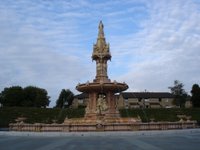
We came upon this:

The Doulton Fountain, the largest terracotta fountain in the world. Sorry about the photo. But, basically, it's a symbol of Victorian Empire. QV stands at the apex, her soldiers just below her, with four lands under her authority: Canada, South Africa, Australia, and India.

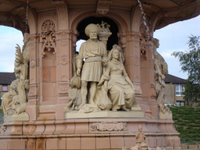
Here's India:


JJ immediately recognised the Indian figures. He was sure that the man was the Muslim Mughal Emperor Shah Jahan, and that the woman was his favourite wife, Mumtaz Mahal. Shah Jahan built the Taj Mahal as a mausoleum for her.


As Joyson told me the story, I found it difficult to think that these two figures really represented Shah Jahan and Mumtaz Mahal. But, I haven't found evidence to contradict JJ's claim. And, what I have read about the fountain suggests that the figures are representative of the lands under Victoria's reign. So, the chronological differences needn't rule out Joyson's story.


Here are the flowers I promised too. The City Fathers know how to brighten up Glasgow:

Reframing the Reformed (or, Turkeys voting for Christmas?)

This post is not for the faint hearted. But, whatever you do, log-in tomorrow for a post - Flowers, Fountains and Flatmates. It will be a little easier, and it will contain pictures from my own private collection!

Sage and onion is the classic combo for a really tasty stuffing. Nothing at all to do with The Foolish Sage, a blogger I discovered early in my blogging career. Mark was, perhaps still is, a student at Westminster Theological Seminary in Philadelphia. His posts are usually good quality book reviews or thoughts on all things reformed, evangelical, theological, and ecclesiological. I quickly learned loads about evangelical Presbyterianism in the US through reading Mark's posts, and following the discussions that followed.

In a recent post Foolish Sage touches on a subject that has bothered me for a long time. In fact, Mark republishes his review of Mark Strom's Reframing Paul: Conversations in Grace and Community. I've not read this book. But I get the feeling I will need to look at it soon.

Apparently, Strom considers Paul the Apostle's view of church life. You can read the review for yourself (this paragraph is my paraphrase of one aspect). Strom provides a serious challenge to the Reformed view of church as a word centred environment. Currently, meeting as the church means gathering to listen to the preaching of God's word. As a consequence the church has become pastor/preacher centred. Strom thinks that this is actually the kind of thing Paul opposed, because Strom compares typical Reformed models of preaching and teaching in church with the Greek thinkers prominent in the first century. He refutes the notion that modern Reformed evangelical norms find any model in Paul's way of Christian ministry.

Nothing seriously new with these ideas. I've thought along these lines for some time, mostly because of the influence of one or two seriously on-the-ball Christian friends and ex-flatmates.

The new thing that began to bother me was the implication of this line of thinking. I did some research on Strom, and, among other things, I came across this interview with Tony Payne. It's from 2001, and it includes this quote about Strom's unease with modern theological education:

...about what's taught at Moore, or Westminster or wherever. I see a lot of good things taught in these places. The emphasis on biblical theology is a welcome shift. But I also see a social system that remains and that is at odds with that very biblical theology. It makes it even more intolerable to me. If I thought in terms of classical theology, then at least this hierarchical structure could be rationalised. But once I see church in terms of biblical theology, as the assembly of God's people which emerged through Israel's history and culminated in Christ--if we took this really seriously, none of us would end up arguing for the conventions of being an Anglican or Presbyterian or Baptist or whatever.


I'm obviously a fan of biblical theology. I wrote Days are Coming. I studied at Westminster which was largely responsible for its modern revival as a method of doing theology. But I believe the method and its practitioners never fully left the split behind. Now we see a split between redemptive history and so-called 'ordinary' history. Some of the scholars with whom I have interacted operate with two constructs in their minds; ordinary history, the sources of first century social history, which is profane, and redemptive history which is the only pure and proper history. This can only, in the end, reinforce our disengagement from the world.


Strong stuff. But if the way ahead is one without traditional forms of church, what role do pastors or seminary principals or theological teachers fulfil? Is Strom really hoping to do his students out of future employment? Turkeys for Christmas?


This all reminds me of a thought I sometimes share with people. The church as we know it in the UK is full of problems. I am preparing to become a servant of that church, a knight in shining armour to save the day, perhaps? No, just the opposite, it turns out. If Strom is right, the moment I become a minister in the CofS I will become part of the problem. So, either I should vote for Christmas, or I should start a campaign to ban it. Thing is, I really love my sage and onion stuffing...